What Is SEO?
Search engine optimisation is the process of improving your website so it ranks higher in search engine results. Google crawls your site, indexes your pages, and ranks them based on hundreds of signals - keyword relevance, backlinks, site speed, mobile performance, content quality, and user experience among them.
The goal is straightforward: when someone searches for what you do, your site appears. You earn the click. They land on your page. From there, it's your job to convert them.
SEO has been the foundation of organic visibility for over two decades. The tactics have evolved - keyword stuffing died years ago, and technical SEO now covers everything from Core Web Vitals to structured data - but the principle hasn't changed. Create useful content, make it technically sound, build authority, and search engines reward you with traffic.
What Is GEO?
Generative engine optimisation is the practice of structuring your content so that AI-powered platforms cite, reference, or recommend it when users ask questions. Those platforms include ChatGPT, Google's AI Overviews, Perplexity, Claude, and Gemini.
Where SEO gets you onto a list of results, GEO gets you into the answer itself.
When someone asks ChatGPT 'what's the best way to improve my local search rankings?' - the response it generates pulls from sources it considers credible, authoritative, and clearly structured. If your content ticks those boxes, you get cited. If it doesn't, you're invisible in that conversation entirely, regardless of where you rank on Google.
That's the shift. Traditional search gives users ten links and lets them choose. Generative search gives users one synthesised answer and decides which sources to include. Your content either makes the cut or it doesn't.
SEO vs GEO - The Key Differences
The two share the same end goal - getting your business in front of the right people - but they work differently under the surface.
| SEO | GEO |
|---|
| Target | Traditional search engines (Google, Bing) | AI platforms (ChatGPT, Perplexity, Google AI Overviews) |
| Result type | A list of links the user chooses from | A single synthesised answer citing sources |
| Success metric | Rankings, organic traffic, click-through rate | Citations, mentions, inclusion in AI responses |
| Key signals | Keywords, backlinks, technical performance | Content clarity, authority, structured data, entity recognition |
| Content approach | Keyword-optimised, intent-matched pages | Conversational, clearly structured, directly answers questions |
| Traffic model | User clicks through to your site | User may get the answer without clicking - but your brand is present |
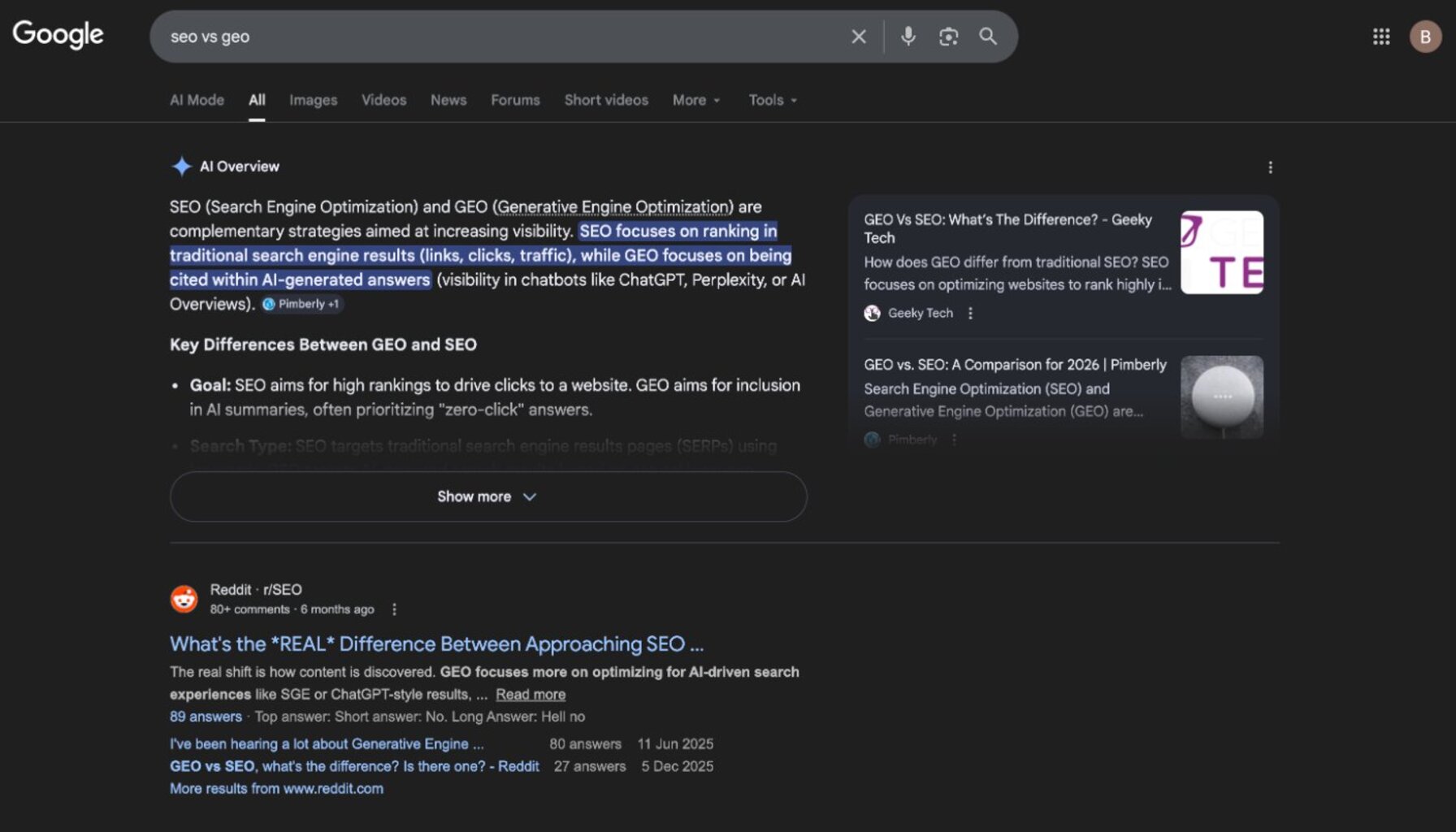
The biggest practical difference is in the traffic model. SEO drives clicks. GEO drives visibility - but that visibility doesn't always come with a visit to your website. The user gets their answer inside the AI interface, and your site is listed as a source they may or may not click.
That sounds like a problem, and for some queries it is. But the data suggests that when users do click through from AI platforms, they convert at significantly higher rates than traditional organic traffic. They arrive already informed. They've read the summary. They're further along in their decision.
Is SEO Dead?
No. And anyone telling you otherwise is either selling something or hasn't looked at the numbers.
AI referral traffic is real, but it's still a small fraction of what traditional search delivers. One content platform tracked their AI referrals over eight months and found that ChatGPT - which accounted for 97% of all their AI traffic - still sent orders of magnitude less than Google organic. Every single article that got cited by ChatGPT ranked on Google first.
That last point matters. The pages AI platforms choose to cite are almost always pages that already perform well in traditional search. Google's AI Overviews pull from its own index. ChatGPT's search function references pages it considers authoritative - and authority, in practice, means strong backlinks, topical depth, and technical soundness. The same things that drive SEO performance.
Research from SparkToro found that over half of Google searches now end without a click. AI Overviews are accelerating that trend. But 'fewer clicks' doesn't mean 'no value.' It means visibility works differently now. Your brand can be present in the answer even when nobody visits your site - and when they do visit, the intent is stronger.
SEO isn't dead. It's the foundation that GEO is built on. Without it, there's nothing for AI to cite.
Where SEO and GEO Overlap
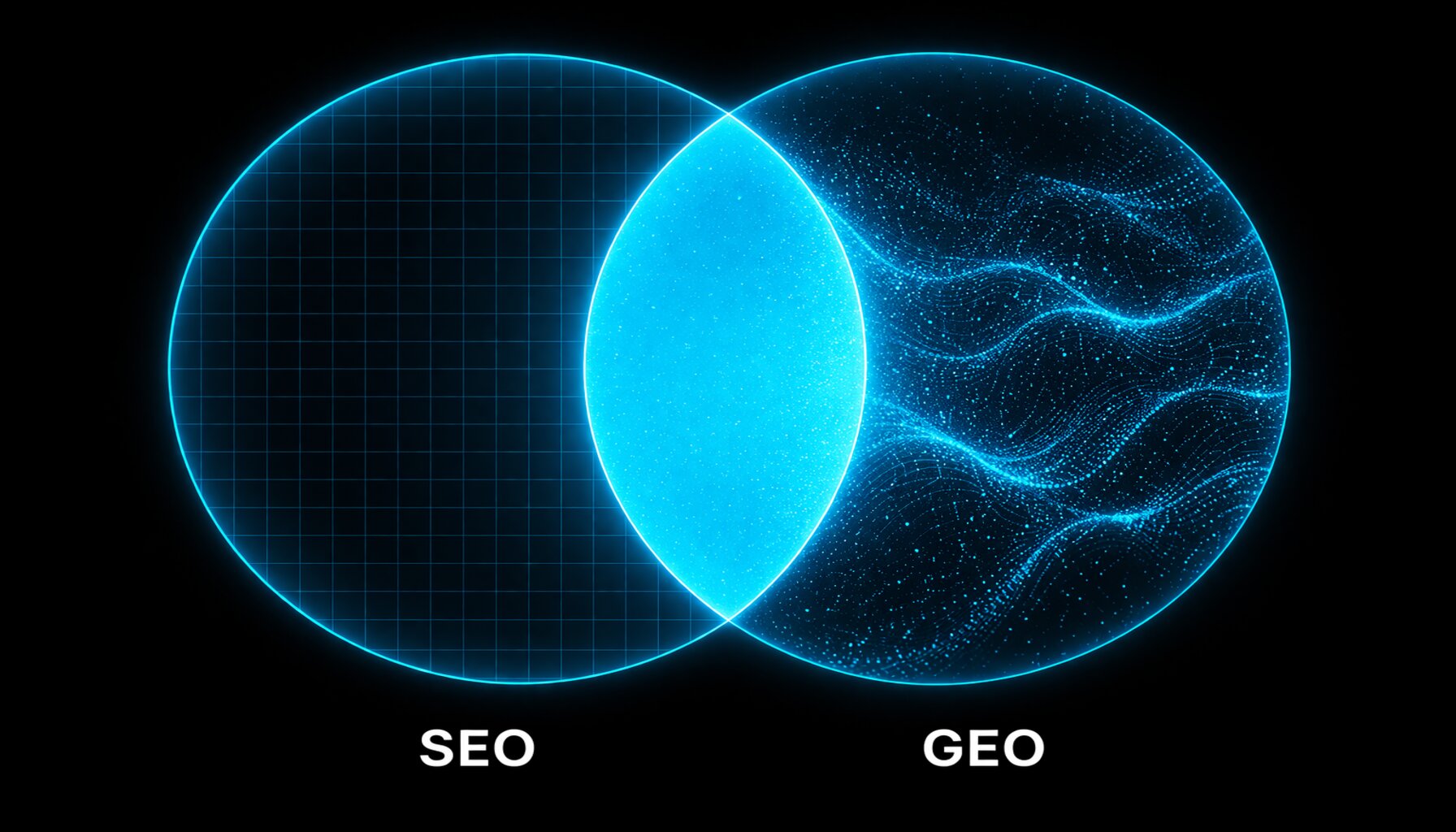
More than most people realise. The tactics that make Google rank your content are largely the same tactics that make AI platforms cite it.
E-E-A-T applies to both. Experience, expertise, authoritativeness, and trustworthiness aren't just Google's guidelines anymore. AI models prioritise content from sources they consider credible. If your site has strong author signals, accurate information, and a reputation backed by quality backlinks and brand mentions - you're well positioned for both.
Content quality drives outcomes in both. Thin content gets ignored by search engines and by AI. Original research, specific detail, clear explanations, and direct answers to real questions perform well everywhere. There's no shortcut here, and there never has been.
Structure increases visibility in both. Clear headings, short paragraphs, well-labelled sections, and descriptive tables help Google understand your content and make it easier for AI models to extract and reference. A well-structured page is a well-structured page regardless of who - or what - is reading it.
User intent matters in both. SEO has always been about matching search intent. GEO takes that further - AI platforms need content that directly and clearly answers the question being asked. Vague, keyword-stuffed pages that dance around the answer without providing one will struggle in both channels.
The research paper that originally defined GEO (published at ACM SIGKDD 2024) found that the content improvements producing the highest citation rates in AI responses were 'authoritative statistics' and 'fluency improvements.' Those are the same characteristics Google's own quality guidelines reward. This isn't a coincidence.
How to Optimise for Both SEO and GEO
If your SEO is already strong, you're closer to good GEO than you think. A few targeted adjustments can significantly improve your visibility in AI-generated answers without undermining your organic rankings.
Content Structure and Clarity
AI retrieval systems prefer content that leads with the answer. Not background. Not a three-paragraph introduction. The answer.
If someone is going to search 'what is generative engine optimisation,' the first paragraph of your section on that topic should define it clearly and directly. Supporting detail comes after. This 'answer first, context second' approach mirrors how featured snippets work in traditional search - and it makes your content easier for AI to extract and cite.
Write each section so it can stand on its own. AI platforms pull individual chunks of content, not entire pages. If your key point is buried three paragraphs into a section behind qualifying statements and background context, it's less likely to be selected.
Structured Data and Schema
Schema markup helps search engines and AI models understand what your content is about, what entities it references, and how the information relates to each other. FAQ schema, article schema, and organisation schema all provide explicit signals that improve how your content is interpreted.
This falls under technical SEO, and it's the kind of foundational work that most businesses haven't done properly. The payoff is dual - better structured data improves your chances of appearing in featured snippets, rich results, and AI-generated responses.
AI Crawler Access
This is the one most businesses haven't even thought about. If your robots.txt file blocks GPTBot, ClaudeBot, PerplexityBot, or Google-Extended, your content is completely invisible to those AI platforms. It doesn't matter how well-optimised it is.
Traditional SEO robots.txt management focuses on Googlebot and Bingbot. GEO requires you to check whether AI crawlers can actually access your site. It takes five minutes to check and fix, but without it, nothing else matters.
Go and look at your robots.txt file right now. If you see Disallow directives for any of the AI crawlers listed above, that's your first GEO fix.
Which Strategy Should You Focus On?
Both. But not as two separate strategies with two separate budgets and two separate agencies. That's overcomplicating it.
What you need is one search strategy built on strong fundamentals - technically sound website, authoritative content, clear structure, proper schema markup, and a consistent approach to building credibility. That strategy serves Google, AI platforms, and your customers all at once.
If your SEO foundation is weak - slow site, thin content, no structured data, poor internal linking - fix that first. AI platforms aren't going to cite content that Google can't even rank. The foundation comes first. Always.

If your SEO is already in good shape, the adjustments for GEO are targeted, not transformational. Lead with direct answers. Tighten your content structure. Implement schema. Check your AI crawler access. These are refinements, not a rebuild.
The businesses that will struggle are the ones treating GEO as something entirely new that requires a separate playbook. It doesn't. It requires the same playbook, executed with more precision.
We already work this way. Every SEO audit we run covers the technical foundations that support both traditional search and AI visibility. Every content strategy we build is structured for humans and machines alike. GEO isn't a bolt-on service - it's baked into how modern SEO should be done.
If your current setup isn't delivering visibility across both channels, it might be time to look at what's missing. Get in touch and we'll tell you where you stand.